It has been raining all the time lately. It falls, pauses for a while, then starts again. Looking out the window, I catch myself wondering: was autumn always like this?
Japan has always had long spells of autumn rain. There is an autumn rain front, and typhoons can stir it into heavier rainfall. Perhaps I have simply polished the autumns I remember. I do not want to look at today’s rain and declare that climate change explains every drop.
Even so, my body keeps saying, Something feels different. The calendar says autumn, but summer still lingers in the damp air. The rain seems to stay longer, and the paths taken by typhoons no longer feel as familiar. The border between seasons has become a little harder to read.
Weather comes closer to the ground where the horses live
By evening, it is time to go and care for the horses. Strangely, the rain often eases just as I step outside. I make a tiny victory pose in my head and offer the sky a surprisingly sincere thank-you.
At the horses’ place, the rain I had been watching on a weather screen suddenly reaches the ground. The softness of the soil. The wetness of the grass. The smell of the air. The horse’s body, and the damp held in its coat. It is the same place I visit on a clear day, yet the world feels entirely different to the touch.
I am still learning about horses—and leaning into it rather enthusiastically. How does a hoof work? What changes when rain continues for days? How does a horse experience humidity and temperature? Every answer seems to produce three new questions. I may be a beginner, but I am becoming obsessive at remarkable speed.
Since horses entered my life, I no longer read the weather only by looking at the sky. I look at the ground, the grass, the horse’s body, and the horse’s mood. My point of observation has moved closer to the earth.
On the way home, a sweet fragrance stopped me. Fragrant olive.
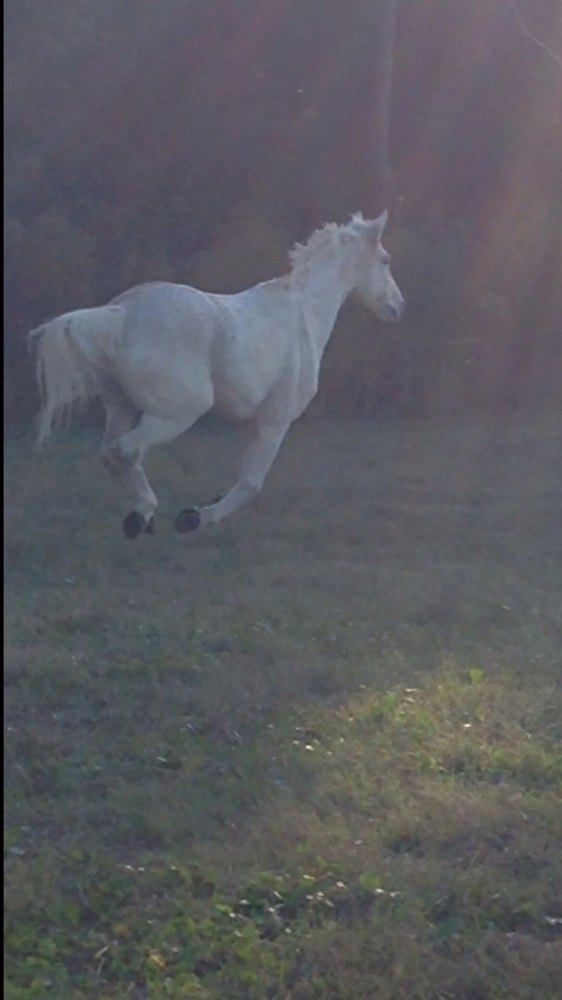
has moved closer to the ground.BEERSROBERT000 / HORSE RUNNING / 2012 / CC0 1.0
Oh. Autumn.
Sometimes the season arrives as a scent
I had spent the morning watching rain while thinking about world news, markets, and this Digital Museum. Then the season announced itself with a single scent. Faster than any calendar. I love moments like that.
Perhaps a season does not arrive by date alone. It comes through smell, wind, insects, the dampness of the air, and the temperature against the skin. The body notices first: something has changed. That may be why the old seasonal calendars remain so compelling. They were not made from numbers alone, but from accumulated observations of sky, plants, animals, and daily life.
Fish-scale clouds, and the thought of saury
Small clouds sometimes gather across the autumn sky like fish scales. When I see them, my first thought is not, How autumnal. It is, I want a delicious Pacific saury. They are called sardine clouds, and still I think of saury. So much for poetic refinement.
Saury, too, belongs to the season. Once, “autumn means saury” felt simple. Now news about prices and catches reveals ocean temperature, currents, migrating fish, fisheries, fuel, and distribution behind a single fish on the table. Far more relationships are required to bring dinner home than I used to imagine. And somehow, this makes me want to listen to rakugo.
All of it belongs to the same day
Seen this way, rain, horses, fragrant olive, and saury stop being separate subjects. A thought about climate wanders into a horse’s hoof, then into scent, and finally lands at the dinner table. While building this Digital Museum, I suspect this endless movement is exactly what interests me.
The world does not live in categories. We name things afterward and place them on shelves. Life delivers them all at once.
I return home and open my computer, ready to continue working on the Museum. Beneath the desk is a cat. While I am thinking about the relationships of the world, it bites my toe. Ouch.
Rain. Horse. Fragrant olive. Saury. Cat. A large white dog. Digital Museum. Today, they all belong to the same day.
Right. Time to go and buy some saury.